
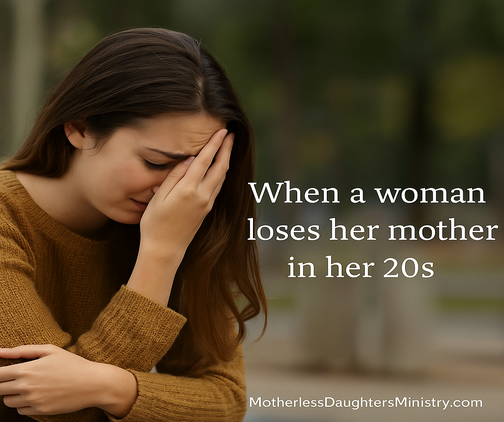
There’s no “good” age to lose your mom—but losing her in your 20s? That’s a very particular kind of pain. You’re old enough to be out in the world, starting your adult life. But you’re still figuring it all out—who you are, where you’re going, and how to make sense of life on your own.
And suddenly, she’s not there. Not there to cheer you on at graduation. Not there to help you prep for interviews or settle into your first real apartment. Not there to tell you how to get stains out of a blouse or navigate messy relationships. She’s just… gone. And it can feel like someone cut your anchor line, leaving you adrift.
If you know a woman in her 20s who’s lost her mom, you might be wondering:
What do I say? How can I help?
Here’s what she may be feeling—and how you can support her with words that heal, not hurt.
Skip the clichés like: “She’s in a better place.” “At least you’re an adult now.” “Time heals all wounds.” These can unintentionally invalidate her pain.
Instead, say things like: “I’m so sorry. This is such a huge loss.” “I don’t have the right words, but I’m here for you.” “I can’t imagine how hard this must be—how are you doing today?” Let her know she doesn’t have to perform strength for you.
Women in their 20s are often starting new jobs, finishing school, falling in love, getting married, or just beginning to feel like they’ve got their footing. And then the bottom drops out. This is a time when she’s naturally trying to separate from her parents and form her own identity (a developmental process called individuation). But that process usually requires a secure base to return to—someone to call, someone to reassure her she’s okay, someone to remind her who she is.
When a mother dies during this stage, that foundation disappears. She may feel completely alone in her adulting journey, overwhelmed by decisions she used to ask her mom about, angry at the timing of the loss, guilty over unresolved issues from their relationship, or isolated when no one else her age seems to “get it.” Her grief is doing the heavy lifting behind the scenes.
Here are a few meaningful phrases that go a long way: “You don’t have to have it all figured out. This is a lot.” “What do you miss most about her?” “If you ever want to talk about her—or even just sit in silence—I’m here.” “You’re doing better than you think, even on the hard days.” “Would it help if I came over with dinner or took something off your plate this week?”
One of the best things you can do is remember. Remember the milestones. Remember her mom’s birthday. Remember that Mother’s Day might hurt. A simple message like: “Thinking of you today. I know this holiday can be really hard.” Or “Just wanted to say—I bet your mom would be so proud of everything you’re doing.”Small words. Big impact.
Not all mother-daughter relationships are close. If your friend’s relationship with her mom was difficult or unresolved, her grief may be more complicated. She may feel guilt, confusion, or even anger. If she opens up about that, don’t minimize it. Say: “It’s okay to grieve what was… and what wasn’t.” “You don’t have to make her a saint now that she’s gone. Your feelings are valid.” “Grief is messy. I’m here for all of it.”
Sometimes the silence around complicated grief can feel even heavier. Your willingness to sit in the complexity with her is a gift. She might be okay one minute and crying the next. She might want to talk—or not. She might disappear for a bit. That’s okay. Don’t rush her. Don’t try to fix it. Just keep showing up with grace and compassion.
Say: “No pressure to reply—I just wanted you to know I’m thinking of you.” “Want to watch a movie or go for a walk? No grief-talk unless you want to.” These small offerings give her space to be where she is. You may not have answers, but you do have presence. And that presence can become a grounding force in the middle of her storm.
Women in their 20s are often expected to have it all together, but losing a mother can unravel even the strongest-seeming person. In the months following her loss, she might still be showing up at work, laughing with friends, or posting online—but that doesn’t mean the grief has lifted. It just means she’s learning how to wear the mask that the world expects.
Be the person who doesn’t expect the mask. Be the one who says, “You don’t have to be okay for me.” When you give her that space, you give her permission to breathe again. Permission to be real. Permission to grieve at her own pace. The more you normalize her grief, the less isolated she’ll feel.
If you’re not sure how to keep showing up, set reminders. Put her mom’s birthday in your calendar. Set a note to check in a month or two later. You don’t need to have long conversations—just a quick, “Thinking of you,” can speak volumes. Your consistency will help rebuild the feeling of a steady ground under her feet.
Grief doesn’t come with a user manual. It’s confusing, exhausting, unpredictable—and deeply personal. That’s especially true when you’re 24, 25, 28 and suddenly feel like you’ve lost the person who held the map to your future. You can be the person who sits with her while she figures out a new map. One that includes her mom in a different way. One that doesn’t ask her to forget, but encourages her to carry love forward.
Remind her: Her mother is still with her in the way she speaks, in how she shows kindness, in her laughter, in the recipes she makes. In the way she comforts others. She carries her mom in every part of who she is becoming.
Your presence won’t erase the pain. But your compassion, your words, and your willingness to keep showing up? That’s the kind of support that stays with someone for life.
💛 Know someone in their 20s who’s lost their mother? Send this to them. Or better yet—send yourself. With open hands, a listening heart, and the courage to say, “You don’t have to walk this alone.”
Reach out to us: www.MotherlessDaughtersMinistry.com