
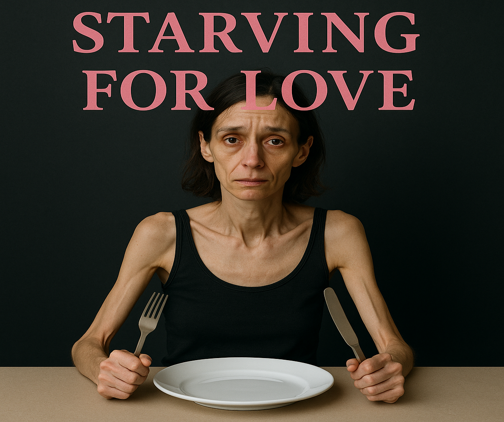
How years of shame, silence, and starvation broke me—until it didn’t.
I grew up in a house where my body was never mine. My mother, morbidly obese, cruelly self-absorbed, and deeply narcissistic, used my size as a measuring stick for her mood. She worshipped my thinner younger sister, while she shamed me in private and in front of others. Her words were precise and merciless: “Everyone is looking at you,” she’d say. “Look how the fat on your legs folds over when you sit. People can’t believe that you are your sister’s sibling; there is so much daylight between the two of you.” Those words landed like blows, over and over, until I learned to hate the body I lived in—and myself.
What never ceases to amaze me is how blind I was to the obvious. My mother was morbidly obese at a time, the 1970s, when this was very uncommon. And yet, somehow, it never occurred to me that she was the one who was obese, not me. I loved her. I wanted her. I needed her. I wanted to prove my worth to her. So I chased a ghost: proof of love that would never come. It was a never-ending cycle of futility.
I became a master at starvation. Staying critically underweight felt like the only strategy that could win me a sliver of approval. I did everything possible to bury my true feelings and silently beg for love and acceptance. Each calorie I denied myself was a secret offering, a plea to the universe that controlling the size of my body would be the thing that would finally earn her love.
At eighteen I landed in the hospital for the first time. I remember terror: the mechanical clatter, the coldness of the staff, the numbness of hunger, the choking panic of being force-fed through a feeding tube. The caregivers were hurried and uncompassionate; the experience made me feel ashamed of myself and my body all over again. My mother never visited. She never comforted me, never sat with me through the fear. She never spoke with me about it, even after I was discharged. Instead, she carried the story like a grievance, embarrassed, as if I had made her into a villain, even though I never accused her of anything, not to the staff, not to anyone.
My mother’s absence compounded in the years following this first of many hospitalizations. The lack of care, the public shame, the worship of my sister—all of it taught me that my needs were a nuisance, that my body was a battleground where her love was rationed by size. For over thirty years, anorexia was my shadow. It was my punishment and my armor; it was how I sacrificed to become someone worthy of love.
Now, at 56, I carry long-term physical damage from all those years: chronic issues with my heart and kidneys, and bones with the composition of Swiss cheese. These are the physical reminders of how hard I worked to be loved and earn the right to have my love returned.
These scars have become a commitment: I don’t want even one more of my motherless sisters to endure slow violence against their bodies in the name of earning affection.
Here’s the truth I want every worthy, beautiful motherless daughter to hear: the cruel voice in your head is not yours. It’s an echo of someone else’s wounds, a script handed down and mistaken for truth. Relearning who you are means learning to recognize that voice and learning to disobey it. For once, being disobedient rather than blindly compliant—and perhaps even learning to enjoy this “naughtiness” you never allowed yourself in pursuit of unattainable maternal love.
For me, healing has been very slow. It’s been about learning to feed myself not performatively, but with real intention. It’s been learning to practice tenderness where self-harm once lived. And some days it’s really lovely — a delicious bowl of chicken soup eaten while naming three things I like about myself— and some days it’s difficult therapy, forcing myself to eat when I don’t want to, or simply sitting with the little girl who was consistently humiliated but refused to turn away.
Like so many of us, I am reparenting myself. Reparenting is not blaming and being critical of my past; it’s reclamation. It’s writing the loving scripts I should have heard as a child: You are seen. You are worthy. You do not have to starve to be loved. Each time I feed my body with kindness, each time I choose rest over self-punishment, I take another step toward becoming the healthy, vibrant woman I was meant to be.
If you grew up under the cruelty of a narcissistic mother, worshipping a golden child while scolding the “scapegoat,” you are not broken! If you have spent years trying to shrink yourself to fit someone else’s expectations, you can still grow into the unique, extraordinary woman you are! Sure, the path is rocky, and you’ll get stones in your shoes. But the destination is full of sunshine: a life where you care for yourself because you are worthy, not because you’re trying to earn your mother’s love.
This is my invitation to anyone still carrying their mother’s cruel voice: release it into the wind. It was never yours. Feed the child inside you with a bounty of delicious, nourishing food and friendship. Speak out loud the words you needed to hear. There is a life full of light and love waiting for you just on the other side of clarity, that begins one small, brave meal at a time.
2 replies on “Starving for Love: My 30-Year Battle with Anorexia and the Mother Who Couldn’t Love Me”
The timing of this post could not have been better. I’ve been grieving my Mother who also “worships” my younger sister. She never acted so cruel when I was a child, but now that I’m in my 40’s with a young child all of a sudden she has started playing favoritism games with her daughters and grandchildren. It came as a huge surprise at this season and stage of life when I’m navigating Motherhood myself. It’s a hard truth to swallow that she is not able to treat her children and grandchildren fairly and equally. It’s very confusing now, how to manage boundaries when I have a 5 year old daughter without confusing her. It’s is beyond cruel.
The timing of this post could not have been better. I have recently been grieving my narcissistic mother who also “worships” my manipulative sister.
She never acted this way when I was a child. Now, as a middle-aged adult with a young child she has been playing favoritism games with her daughters and grandchildren. It came as a surprise at this stage and season of life that she would start to act so cruel, just as I am navigating motherhood, myself. It is it such cruel treatment. And I feel sorry for my daughter that she won’t be able to have a kind and healthy relationship with her grandmother as she seems more preoccupied with mean-girl games and control over love and nurturing. I wish that there was an answer or cure to healing narcissism as it seems to be the root cause of so much family dysfunction. I now see and know how much damage this type of bullying does to someone. So I can’t even image what you must have gone through your entire life. I’m so sorry you had to experience that. We all deserve better.