
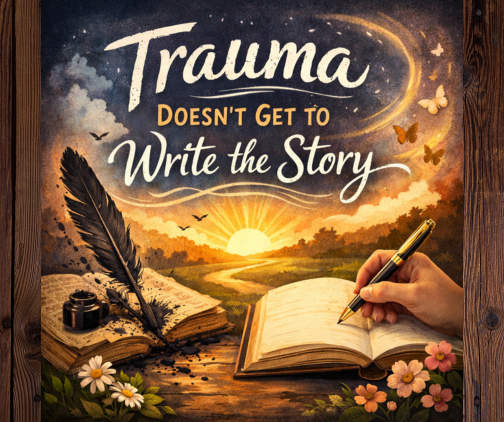
Trauma has a way of arriving uninvited and overstaying its welcome. It enters quietly or crashes in loudly, leaving behind confusion, grief, fear, and unanswered questions. For many women—especially motherless daughters—trauma isn’t a single moment. It’s layered. It can be the early loss of a mother, emotional neglect, abandonment, abuse, or growing up without the steady presence of someone who saw you, soothed you, and showed you how to belong in the world.
Trauma is powerful—but it is not all-powerful.
One of trauma’s greatest lies is that it gets to define you.
- That what’s happened to you is the most important thing about you.
- That your pain is the headline, the conclusion, the final chapter.
Trauma wants to write the story as if the worst moment is the whole book. But trauma doesn’t get to write the story.
Trauma Is Something You Experienced—Not Who You Are
Trauma shapes how we see the world, ourselves, and others.
- It can alter our nervous systems, our attachment patterns, and our sense of safety.
- It can leave us hypervigilant, emotionally guarded, or stuck in cycles of self-blame and shame.
These responses are not character flaws; they are survival strategies. But survival is not the same as identity.
You are not
- “The abandoned one,”
- “The unseen one,”
- “The broken one.”
Those may be chapters, but they are not the title. Trauma may have influenced the plot, but it does not own the pen. When we allow trauma to narrate our lives, the story becomes narrow.
Everything gets filtered through pain:
- Relationships feel unsafe
- Joy feels temporary
- Hope feels risky.
Trauma tells us, “This is how it will always be.” But trauma is speaking from fear, not truth.
The Difference Between Being Wounded and Being Written Off
There is a profound difference between acknowledging trauma and surrendering authorship to it. Healing does not require denying what happened. It requires refusing to let what happened have the final word.
Trauma says:
- “You are too much.”
- “You should have known better.”
- “You are behind.”
- “You will always be alone.”
Healing says:
- “You adapted to survive.”
- “Your responses made sense.”
- “You are allowed to grow at your own pace.”
- “Connection is still possible.”
Trauma often freezes us in time, keeping us emotionally anchored to an earlier version of ourselves—the frightened child, the grieving daughter, the woman who had to grow up too fast.
Healing invites us to gently unfreeze, to bring those parts with us rather than letting them run the story.
Reclaiming Your Pen, One Line at a Time
You don’t reclaim your story all at once. You do it in sentences. In moments. In small, courageous choices.
- You reclaim it by naming what happened without minimizing it.
- You reclaim it when you stop explaining your pain to people committed to misunderstanding you.
- You reclaim it by choosing rest over proving your worth through exhaustion.
- You reclaim it by allowing yourself to feel joy without waiting for something bad to follow.
For motherless daughters, reclaiming the story often includes grieving what never was: the guidance, protection, affirmation, and comfort you deserved but didn’t receive. That grief matters. Ignoring it gives trauma more space to speak. Honoring it—safely, compassionately, and in community—begins to loosen trauma’s grip.
Trauma Wants Silence. Healing Invites Voice.
Trauma thrives in isolation. It tells you to stay quiet, to stay small, to not make waves. It convinces you that your story is too heavy, too messy, too inconvenient.
But healing grows in witness.
When your story is heard by someone who doesn’t rush you, fix you, or judge you, something shifts. The story begins to change—not because the past is rewritten, but because the meaning is transformed. What once felt like evidence of your weakness begins to reveal your resilience.
- You survived. That matters.
- You are still here. That matters.
- You are still becoming. That matters.
You Are More Than the Worst Thing That Happened to You
Trauma will try to convince you that your life is a series of reactions rather than a sacred unfolding. But your story includes wisdom gained, compassion deepened, boundaries strengthened, and courage refined through fire.
- You are not behind.
- You are not damaged goods.
- You are not disqualified from love, purpose, or belonging.
Trauma may have introduced the conflict, but it does not get to determine the ending.
At Motherless Daughters Ministry, we believe this deeply: trauma doesn’t get to write the story—you do.
- And you don’t have to write it alone.
- Healing is not about erasing the past.
- It’s about integrating it without letting it dominate the future.
- It’s about choosing, again and again, to live from truth rather than from fear.
Your story is still unfolding.
- There are chapters of tenderness ahead.
- There are sentences you haven’t imagined yet.
- There is meaning beyond the pain.
Trauma may have taken a pen for a while—but it’s time to take it back.
The story isn’t over.
And the next chapter belongs to you.