
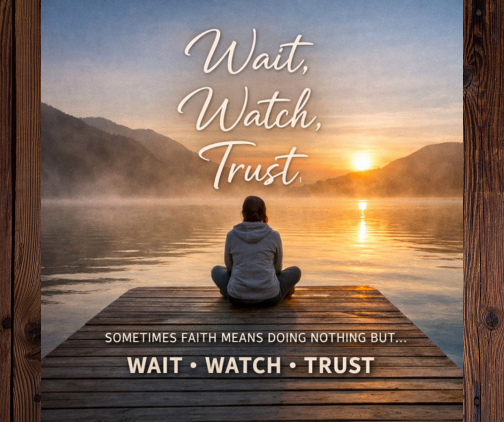
Sometimes Faith Means Doing Nothing but Wait, Watch, and Trust
There are moments in life when faith looks bold and active—starting a ministry, stepping into leadership, launching a new idea, or speaking truth in a difficult situation.
Those are the moments people often celebrate.
They look courageous.
They look strong.
They look like faith.
But there is another kind of faith that receives far less recognition.
It is the quiet kind.
The kind that sits in uncertainty.
The kind that resists the urge to fix, force, or control.
Sometimes faith simply means waiting, watching, and trusting.
For many of us, especially those who have experienced deep loss, waiting can feel uncomfortable. When life has taught you that things can disappear without warning—relationships, security, health, or even the presence of a mother—it is natural to want to take control wherever you can.
Doing something feels safer than doing nothing.
But faith often calls us to a different posture.
A posture of stillness.
A posture that says, “God, I will not rush ahead of You.”
Waiting is not a weakness. In fact, waiting often requires more strength than action. When we wait on God, we resist the temptation to manufacture outcomes. We choose not to manipulate circumstances or push open doors that God has not yet opened.
Waiting requires humility.
It acknowledges that God sees what we cannot see.
It trusts that His timing is wiser than our urgency.
Psalm 27:14 reminds us:
“Wait for the Lord; be strong and take heart and wait for the Lord.”
Notice the words connected to waiting: strength and courage. Scripture does not describe waiting as passive resignation. Instead, it calls it an act of spiritual bravery.
There are seasons when the most faithful thing we can do is simply remain present and attentive.
Waiting does not mean disengaging from life. It means being spiritually alert. It means watching carefully to see where God is moving rather than charging ahead with our own plans.
Sometimes we try to solve problems that God intends to resolve in His own way.
Sometimes we try to answer questions that only time can reveal.
Sometimes we try to close chapters that God is still writing.
Watching requires patience and discernment. It invites us to slow down and observe what God might be forming beneath the surface.
Think about seeds planted in the ground. For weeks, sometimes months, nothing visible happens above the soil. If we judged the process by what we could see, we might assume nothing is happening at all.
But beneath the surface, roots are forming.
Life is preparing itself for growth.
Faith trusts the hidden work of God.
Trust is the final piece of this quiet spiritual posture. Waiting and watching become faith only when anchored in trust. Otherwise, they simply become anxiety-filled pauses.
Trust says, “Even though I cannot see the outcome, I believe God is still at work.”
Trust reminds us that silence is not absence.
Delay is not denial.
Uncertainty is not abandonment.
Many biblical stories unfold in long seasons of waiting. Abraham waited decades for the promise of a son. Joseph waited years in prison before God elevated him. David waited through years of hiding before becoming king.
And perhaps one of the most powerful examples of waiting appears in the story of Moses and the Israelites at the Red Sea. As the Egyptian army approached, panic spread through the people. They wanted to act, run, fight, or turn back.
But Moses told them something remarkable.
“The Lord will fight for you; you need only to be still.” (Exodus 14:14)
Imagine how difficult that must have been to hear. An army behind them. A sea in front of them. And the instruction was simply to be still.
Yet it was in that stillness that God performed one of the most dramatic miracles in Scripture.
Sometimes our activity can get in the way of God’s intervention.
Sometimes God asks us to step back so that His power can step forward.
This kind of faith can be especially meaningful for those who carry grief or complicated histories. When life has included loss, abandonment, or deep emotional wounds, trusting God with the future can feel risky.
But waiting on God is not the same as returning to helplessness.
It is choosing hope.
It is saying, “My story is not finished yet.”
Faith does not always require dramatic steps forward. Sometimes it invites us into sacred pauses where we learn that God is faithful even when nothing appears to be changing.
In those seasons, waiting becomes a form of worship.
Watching becomes a form of prayer.
Trust becomes a declaration of hope.
So if you find yourself in a season when doors are not opening, answers are unclear, and the path forward feels uncertain, take heart.
You may not be stuck.
You may simply be in a waiting place where God is preparing something you cannot yet see.
And in that place, faith may look like this:
You wait.
You watch.
And you trust that God is still writing your story.